Saturday, March 28, 2009

Production

Most of the things that I watch don’t involve me being able to realize what is going on in the film. When I go watch movies, I usually try to not delve too deep into the film to be able to get the most entertaining experience. I also think a lot about how I would be in the same situations as the characters in a film. While watching the opening of Michael Powell’s Peeping Tom, the point of view shot gave me the feeling that I was actually the person attacking the lady. The different point of view shots also gave me this feeling; not only being able to see through the eyes of the man, but also through the “eye” of the camera. It is a scary feeling to feel like you are the one that is about to kill someone, but that is why the film is really good.
I agree with Christian Metz in his essay. Story/Discourse: Notes on Two Kinds of Voyeurism. He explains that the "traditional film succeeds in giving the spectator the impression that he is himself that subject," and gets pleasure when there are no “traces of the subject of enunciation." When movie-goers realize things that are used for production in the film, they feel left down.
I have seen Leni Riefenstahl’s film Triumph of The Will before, but when it was pointed out that you could see the cameras in some of the shots in the film, I felt kind of weird. I didn’t ruin the film, but it did make me realize that the way I was watching film before did not allow me to see things like this. The past couple of movies that I have watched, I have tried to analyze films in a production type of way. I try to pay more attention to how the film was made and why it was done in such a way instead of trying to follow plot and character development. I feel that this also detracts from the full movie watching experience, but I have always been more interested in production that screenwriting.

Saturday, February 21, 2009

Film Noir

When we think of American detective movies from the mid 1900’s, we automatically have a general idea of what this film is going to look like. We expect a world where the colors are only black and white and everything is covered in shadows. We all have an image in our minds, but most of us with no film background have any idea what this type of genre is called. This genre is called film noir and it is a “visual legacy” that transformed from German expressionism, a movement in the 1910’s – 1920’s in drama and film, into what we know of today. However at the time that these films were being created, the directors did not actually know that they were creating a completely new genre of film.
Aside from the visual aesthetics of the film, an audience usually has a decent idea of how the plot is going to begin and unfold. The plot focuses on a detective who is a man of honor and integrity who will always fight for true justice, even though it means they never move socially upward. He encounters many things throughout the film, especially the attention of a mysterious female character who is deeply implicated in the conspiracy. The film usually ends with the detective being able to solve the case, but is not changed by it in anyway. He returns to his life of obscurity, waiting for his next assignment.
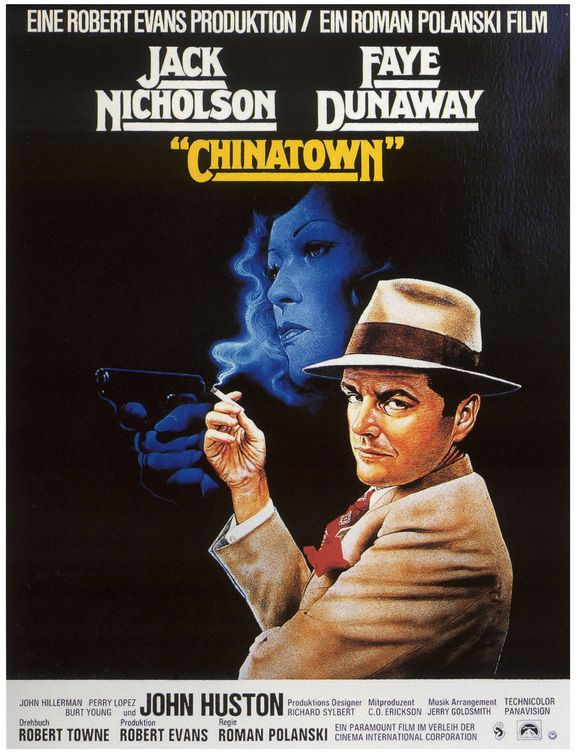
When we first look at the film Chinatown, a film set in the 1930’s that was actually shot in 1974, we automatically start think that the film is going to follow the prototypical outline that all films of this genre are going to follow. All of the qualities are there, besides the fact the film is in color. You have the detective, the darkness, the ambiguity, and a crime. However, Chinatown is not like any film of this type of genre. Both the characters are nothing like prototypical archetypes of the genre. The characteristics of the character played by Jack Nicholson are different from what you expect a private eye to be. Instead of being a moral gentleman at the end, he instead does not solve the crime in the end. The female character, played by Faye Dunaway, is also different from what we expect. Instead of being an independent and courageous woman, she is someone that puts up a visage to hide anguish and ambiguity.
I believe that these evident characteristics are not a mistake made in the film, but are an updated view of film noir. When the prototypical characteristics for film noir were made, society was at a completely different place than where it was when Chinatown was made. The sexual innuendos that were said in the 1920’s and 30’s were something that has become common in films in the 70’s. The depth of character is change that resembles the change of the film from the archetype of black and white to color. The characters in Chinatown are infinitely more complicated than the characters in most of the films that were made in the 1920’s and 30’s. This juxtaposes the depth of characters in the black and white films where distinguishing between the characters was as easy as looking at things in black and white.
As film technology starts evolving, so well the genres of film. No longer will one genre of film be able to tackle certain ideas. An action film will no longer just be seen as an action film. A thriller will now be able to touch on ideas that are pressing issues in our society. A slasher film could potentially make political critiques. As far fetched as this seems, one could only imagine how far fetched the ideas of the future of cinema people had in the 1920’s.

Friday, February 6, 2009

Seeing What We Don't Want to See

Films went through a huge transformation throughout history. When films first appeared, they were nothing but short clips of people moving. But this amazed everyone! No one could believe that the static images that they were seeing were no moving. After D.W. Griffith’s Birth of a Nation, films began to take a different form. Instead of short clips, films were now feature length and expressive. They were expressive in the way that they were trying to evoke an emotion in an audience. Films began to create worlds instead of just replicating the world we already lived in. The most important figure of this time in film was Sergei Eisenstein, who saw the true potential of film as a form of expressive art. Eisenstein’s main method was to use a specific type of editing, known as montage, to evoke an emotion in the audience. As he saw it, combining two shots would cause the audience to think about what they saw and force them to think about how the two shots were interrelated. Eisenstein’s masterpiece was the film The Battle Ship Potemkin, a film that tried to evoke the feeling of revolution in the audience. Eisenstein’s had perfected the method of montage, which is now used in all types of moving image media we use today. All the highlight shows we watch, we have Eisenstein to thank for. All the time we spend getting riled up by a compilation big hits in football and amazing goals is all thanks to him.
However, as film kept developing, the exclusive use of montage in films was disappearing. Now the technique of mise-en-scéne was being used in films. This technique dealt with how the objects in a shot were located. This strayed away from the thought that just editing shots together was enough to evoke emotion from an audience.


We think of language as just words assigned to objects that allow us to communicate amongst ourselves. Films also have the same basic concept of language. It, however, uses it much differently. The different techniques, such as montage and mise-en-scéne, are what films uses as language to tell the audience a narrative. Icons and objects in shots are also used to tell the audience things. Icons have connotations attached to them. The symbols of superheroes, such as the symbols of Superman and Batman, are automatically recognized by an audience as belonging to someone. Directors know this, so putting something on the screen that has an obvious connotation would obviously evoke a bad response from the audience.
Even though every film uses different techniques to try to tell a story, films have one thing in common: the presence of a narrative of some sort. Every single film has characters that progress that progress the story. There is always some sort of conflict and then resolution. But what if we watch a film that does not have closure or some sort of resolution at the end. How are we supposed to feel? We are used to the language of film and are completely thrown off by anything that strays away from this. The film Cache by Michael Haneke does just this. Shots in this are completely different than what we are used to. Some of the shots are much longer than what we are used to. While watching the film, you are looking at all the empty space on the screen, waiting for something to happen. However, when you realize that what you were watching was nothing but a very long establishing shot followed by a tracking shot, you feel a bit cheated. We, as a society, have become to accustomed to quick cuts that lead to immediate action. When something different is thrown at us, we don’t know how to react at all.

Sunday, January 18, 2009

Watching Films for More Than Just The Pretty People

What do you do when you watch a movie? Do you watch the movie for the actors, the settings, or are you one of the few people that watch movies for the plot? Every movie, no matter what genre or what age group it’s aimed at has a plot or narrative. Each plot or narrative follows a specific formula in their movies. There is a protagonist that is introduced to the viewer. In most movies you are supposed to relate to the protagonist and have an emotional connection to them. In the movie “Cinema Paraiso,” we are introduced to Toto, a young boy that becomes infatuated with cinema while peeking in on the censoring process of films in the town’s local movie theater.
I felt a connection to this protagonist because I felt as though I was Toto as a child. I felt I had the same level of curiosity and interest that Toto demonstrated in the beginning of the film.
After a protagonist is established, a conflict must arise. The conflict in “Cinema Paraiso” is that Toto is not allowed to learn how to become a projectionist because his mother feels that it is going to ruin his life. Toto, however, fosters a relationship a father-son with the projectionist since Toto’s father has yet to come back from war and is most likely dead.
Throughout the whole movie, the scenes connect to one another, leading up to the final part of the movie when Toto returns to his old town to go to his mentor’s and “father’s” funeral. As he is brought into his house once again, his mother shows him that she put together all his old stuff. He looks through all of the pictures and goes back to his childhood.
I feel like this film has something for everyone. I feel that it touches so many different aspects of Toto’s life that you are able to connect with him. Since the film goes through all of Toto’s life you can pick any point of Toto’s life and try to relate your life to his. Even though there I have yet to live my whole life, many parts of Toto’s life really hit me hard. There were parts in the movie where one could get very emotional and cry. Not that at was at that point while watching the film, but one could still want to cry because of the movie.
This film also had everything one could ask for in a film. It had parts that were funny, parts that were serious, and parts that made you think. I wasn’t expecting to be so engrossed by the film because of the language barrier, but the scenes were so good that they were not ignored even though there were subtitles.

Sunday, January 11, 2009

What Do You See?

What is expected from us when we read a novel, shown a photograph, or made to listen to music? Each medium asks us to use one of our senses to think about what the artist wants to say. Films, in the other hand, emerge all of our senses at the same time. With the way people are able to multitask these days, it is very easy to see why films have become one of the more favored mediums to present ideas.

Films have always been able to move people in a way that no novel, photograph, or song possibly could. Films are a direct way for someone to tell you their ideas through a combination of words, images, and sounds. You see through the eyes of the filmmaker and get a sense of what that person is thinking or seeing. All other mediums require you to try to perceive what the author or artist is trying to say or portray to the observer of their specific piece of art.

But why do the masses flock to movie theaters with such an enthusiasm that would never be replicated at a bookstore or museum? That’s because films are able to show you the exact settings, characters, and environments that a filmmaker wants you to see. You are able to connect to characters in films in ways that you were never able to before. Since you are able to see and hear these characters, you do not just have to imagine how these characters might be. You can now relate to a character by how they dress just as much as how they act.

As the technology in filmmaking keeps improving, the methods used to create films keep improving. More and more ideas that were once thought to be impossible to create become easy to bring to life. All of these new techniques allow for films to play with our imaginations in new ways. Films are able to transform what we see in the world as completely ordinary and mundane into something that is visually beautiful. In the film “Fight Club” things such as trash or the barrel of a gun are transformed into captivating images. Films can do this through there ability to change the visual presented to you. Close-ups and panoramic shots are commonplace.

A film such as “Fight Club” is a great example of how films completely affect how we view what is around us. Not only does it just affect how we see the ordinary, but it also makes us think of everything in ways we would never imagine. One would never imagine a world where one’s own mind will create something that completely consumes them. A world where you think you are living one life when in actuality you are living a completely different one, a world where anything and everything is possible. “Fight Club” challenges you to view your own life and question everything around you. The film is telling you to not take everything you see as the truth. When films are able to successfully portray messages like this, they automatically show how they have become a better medium than novels, photographs, or music.